
Free tool
Hard water never sends an invoice. Here’s what it bills you anyway.
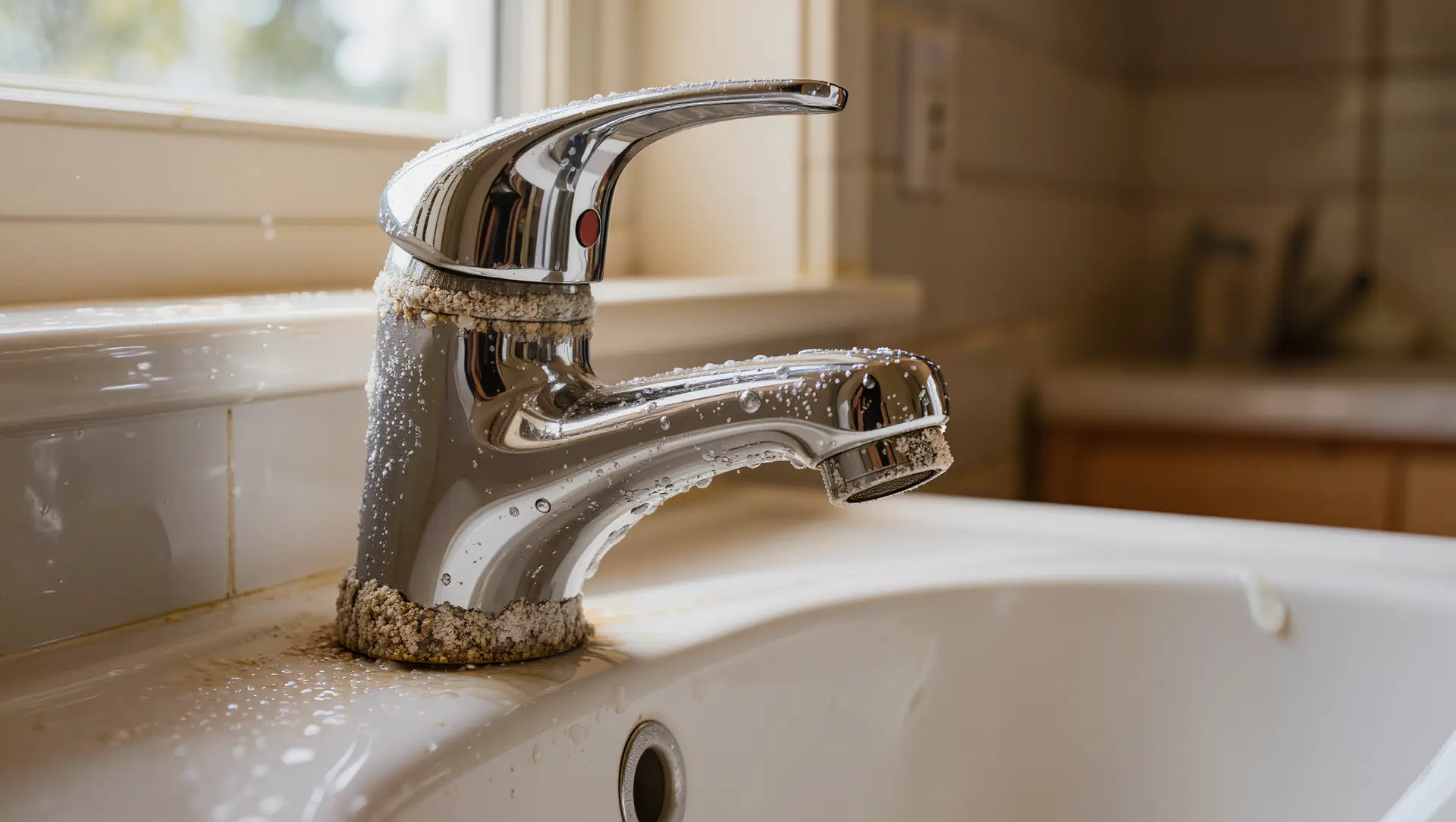
Valley water runs about 12 to 20 grains per gallon. You pay for that through appliances that die young, a water heater working through a layer of scale, and soap that fights calcium before it cleans anything. Set your hardness and household size to see the yearly figure, and how long a softener takes to earn it back.
- LicensedROC #340524
- InsuredFully covered
- BondedWork guaranteed
- 24/7 ServiceEvery day
Phoenix-metro water runs 12–20 grains per gallon depending on the neighborhood. 16 is a fair Valley default; a tap test gives you the real number.
Scale accumulates. An older heater is working through a thicker blanket of it.
What hard water costs you per year
$556
Appliance life, wasted energy, and soap that fights calcium before it cleans.
Appliance life
$270
Heaters, dishwashers, washers, valves retired early.
Energy loss
$106
Heating water through a layer of scale.
Detergent overuse
$180
Roughly double the soap for the same clean.
Softener payback
7.9 yrs
Installed at $1,800–$4,500 (we use the $3,150 midpoint) plus ~$100/yr in salt.
It pays back, slowly.
About 7.9 years to break even at the $3,150 midpoint. That is a real return, not a fast one. If a lower-cost install fits your house, the math improves; if your water heater is due for replacement anyway, protecting the new one strengthens the case. Get a hardness test at the tap before deciding.
The assumptions
- Only hardness above 7 gpg counts — below that, water is soft enough that a softener solves a problem you do not have.
- Appliance-life loss: $30 per excess grain per year — accelerated depreciation across the water heater, dishwasher, washing machine, fixtures, and valves that scale attacks.
- Energy loss: water heating at about $140 per person per year, with a 1.6% efficiency penalty per excess grain (capped at 30%), scaled up for heater age because scale accumulates.
- Detergent overuse: up to $45 per person per year at full Valley hardness. Hard water binds surfactants before they clean; you compensate by pouring more.
- Softener: $1,800–$4,500 installed depending on capacity and loop access, ~$100 a year in salt, and it eliminates about 90% of the hard-water cost — not 100%, because nothing does.
- A family of four at 16 gpg lands in the $500–$800/yr band, which matches Water Quality Association field studies. Your tap may differ; that is what the free test is for.
The number that matters is the one at your tap. We test it free — see water softener installation for pricing and what the test involves.
Reading a cost that never arrives as a bill
The headline figure is a rate, not a charge. Nothing bills you $600 in March. It shows up as a dishwasher replaced at year seven instead of year eleven, a gas bill a few dollars heavier each month as scale insulates the water heater, and detergent bought more often than the label assumes. Spread across a year, it disappears. That is why softener salespeople can overstate it and homeowners can dismiss it: nobody is holding a receipt.
The payback line is the decision. Under six years, a water softener beats most savings accounts and keeps paying for the 10 to 15 years it lasts. Past ten years, keep your money. The calculator will say so plainly, which is more than a brochure will. And if the real complaint is how the tap water tastes, reverse osmosis at the kitchen sink may be the better buy.
One caveat usually works in your favor. The model uses the hardness you enter, and most people guess low. The number that counts is the one at your tap, and we test it free, no purchase required. If the reading beats your guess, run the math again; it tends to get clearer, not murkier. The minerals arrive by way of the Salt and Verde rivers and the CAP canal, and Hard Water in the Valley tells the longer version of what they do once they're inside your house.
Free estimate
Measure it at your own tap.
A free hardness test, the grains-per-gallon reading shown to you on the spot, and a straight answer on whether a softener pays for itself in your house. Sometimes it won’t.
- Flat price, agreed before work starts
- Licensed, insured & bonded · ROC #340524
- Emergency dispatch 24/7
- Veteran owned & operated