Water Heater Repair & Installation in Phoenix & Scottsdale, priced before we start.
How old is your water heater? Most people guess, and most guess low. The real answer is printed on the label, coded into the serial number. Many manufacturers use a letter or a pair of digits for the month and two digits for the year, and searching the brand name plus “serial number date” decodes the rest. If the answer is 10 or more, keep reading.
A tank heater is a steel cylinder with a glass lining and a sacrificial anode rod, a stick of magnesium or aluminum that corrodes so the tank doesn’t. Once the anode is spent, the water goes to work on the steel. Meanwhile the burner or elements heat the water, and every heating cycle drops minerals out of solution onto the tank floor. The tank doesn’t wear out evenly. It rusts through at a weld or a seam, from the inside, usually without warning.
Phoenix is hard on both halves of that arrangement. The water here is some of the hardest of any big American city, so sediment builds fast and anodes are used up early. And the heater usually lives in a garage that passes 120°F in July, or in an attic that runs hotter still, where every fitting, gasket, and plastic part ages faster than the box it came in assumed.
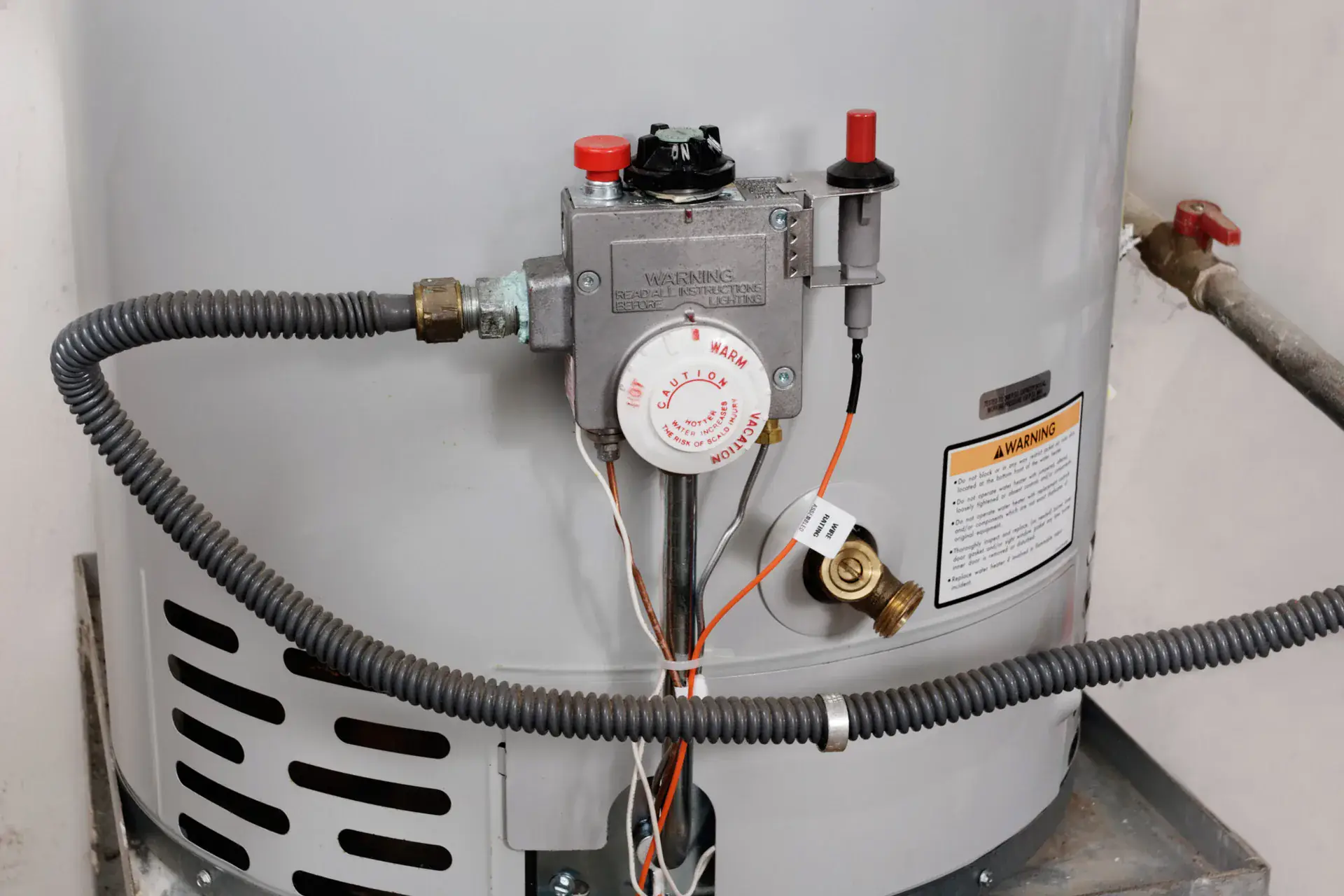
Three checks take five minutes. Look at the base of the tank and the drain pan for moisture or rust flakes. Listen during a heating cycle: popping or rumbling means water is boiling under a crust of sediment on the bottom. Then run a hot tap into a white bucket. Rust-tinted water from the hot side only means the lining has failed. A longer translation guide covers the rest of what a tank says before it quits.
The way tanks fail is what makes the arithmetic lopsided. A tank that lets go doesn’t stop at its own 40 or 50 gallons, because the supply line keeps refilling it until someone closes the valve. In a garage, that’s a mess. In an attic or a hall closet, it’s ceiling drywall, flooring, and a restoration crew, and a leak nobody noticed for a week can cost more than the heater did.
What a failing tank does first
Rusty water, but only from the hot side
If the cold tap runs clear and the hot runs tinted, the steel inside the tank is corroding. No part fixes that. Plan the replacement while you still get to plan it.
Popping and rumbling while it heats
Sediment on the tank floor traps water that flashes to steam beneath it. It wastes fuel and overheats the steel. A flush helps early on; after years of buildup it can stir up more than it removes.
Showers go lukewarm sooner than they used to
Either minerals now fill space that water used to, or a dip tube or element has failed. One is a sign of age and the other is a repair, and a test tells them apart.
Moisture anywhere near the base
Treat it as a tank leak until proven otherwise. Sometimes it’s a fitting or the relief valve discharging, both fixable. Sometimes it’s the tank, which isn’t.
Is the pilot going out?
On a gas unit, a pilot that won’t stay lit usually means a thermocouple or a dirty burner. That is a modest repair in a tank with years left and a poor investment in one that has none.
The serial number says it’s past ten
Age alone isn’t a failure. It is a forecast. At 10-plus years in Valley water, the question moves from whether to replace to when, and a water softener ahead of the new one helps it outlast the old.
How a repair-or-replace visit runs
- 01
Diagnosis first
Age, anode, sediment, burner or elements, relief valve, venting. We test before recommending anything, and a six-year-old tank with a bad thermocouple gets a thermocouple.
- 02
Sized to how you live
Like for like is a habit, not a method. Household size, bathroom count, and whether two showers run at once decide capacity. Sometimes the right answer is smaller than what you had, or a tankless unit.
- 03
A flat price, then the swap
You approve a figure before we disconnect anything. A standard replacement takes two to three hours on site, and the price holds even if the old tank puts up a fight.
- 04
The code items nobody sees
Permit, expansion tank, seismic strapping, drip pan, correct venting, and a relief-valve line that discharges where it should. A buyer’s inspector will look for every one of them.
- 05
Old tank out the door
Hauling it away is included. A dead 50-gallon tank weighs more than it looks and does not fit in the recycling bin.
Installed, most homes
$1,200 – $3,800 installed
A like-for-like tank swap with easy access sits at the bottom of the range. Attic or tight-closet installs, gas line or venting corrections, and code items an old install skipped move it up, as does a tankless conversion. When repair is the honest answer, most repairs land between $180 and $600. Financing is available on replacements.
Financing is available on larger jobsA water heater is the one appliance that tells you, in print, how old it is. Read the label, then pick the day.
Repair or replace? Run it yourself.
Tell it the age and what it is doing. It will give you a straight answer — including "repair it," which is the answer more often than people expect.
Valley hard water retires most tanks around year 10.
Used to size the replacement, not the verdict.
If you replace — installed
$1,950
Tank or tankless, permit included, sized to your household.
Estimated life left
1 yr
Verdict · Get it looked at
Worth a look before you decide.
At 9 years with no terminal symptoms, it could go either way. A quick inspection tells you whether you are nursing it along or genuinely fine. We will give you the straight answer, not the one that sells a heater.
The assumptions
- Lifespan: about 10 years for a tank and 20 for a tankless in Valley hard water — softer water buys a few more, an exhausted anode rod costs a few.
- Replacement, installed and permitted: $1,500–$2,600 for a tank, $2,900–$4,200 for a tankless, sized by household.
- A typical repair — thermocouple, element, or valve — runs about $340. Rusty hot water and moisture at the base are not repairs; the tank is failing.
- This is a guide, not a diagnosis. The only way to be sure is to look at it — which we do for free before quoting anything.
Whatever the verdict, we quote flat before we start and size the replacement to your actual draw rather than swapping like-for-like out of habit. Book a look or call (480) 863-5915.
Water Heaters: questions we get asked
Straight answers, the same ones we give on the phone.