Reverse Osmosis Systems in Phoenix & Scottsdale, priced before we start.
“It tastes like the pool.” That is how a lot of people describe Phoenix tap water, and they aren’t entirely wrong. Utilities add disinfectant so the water stays safe across a very long network of pipe, and in summer the rivers and canals that feed the Valley can bring an earthy, musty note along with it. Add the minerals that make the water hard, and a glass from the tap has a lot going on. Little of it is harmful. Plenty of it is unpleasant.
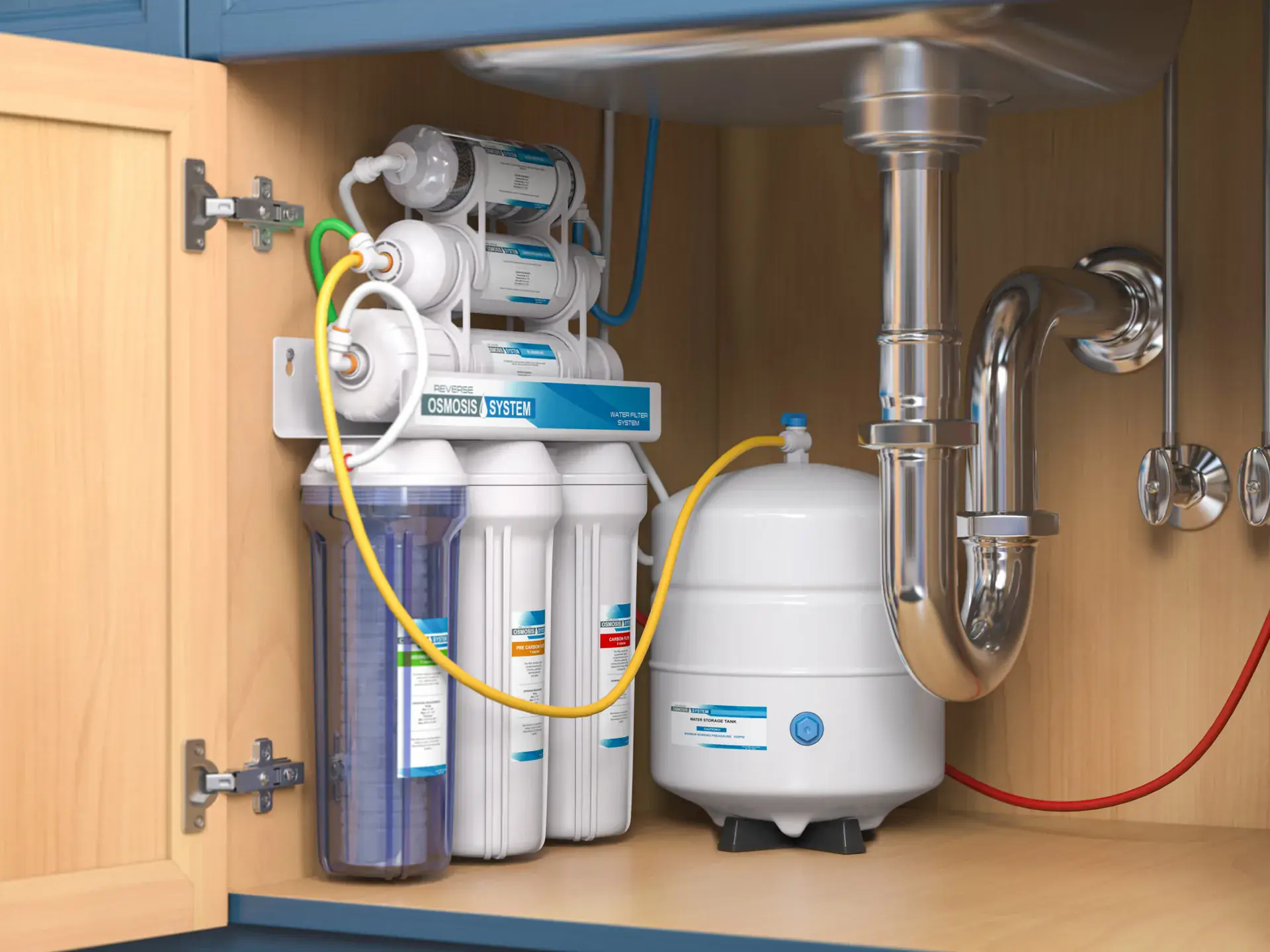
Reverse osmosis cleans water in stages. A sediment filter catches grit. A carbon filter removes chlorine and most of the compounds behind off tastes, which also protects the membrane, since chlorine damages it. Then household pressure pushes water through the membrane itself, a sheet with pores so fine that most dissolved minerals, salts, and metals can’t follow. What gets rejected is rinsed to the drain. The clean water collects in a small pressurized tank and passes through a final carbon filter on its way to the faucet.
In the Valley, the membrane works hard. More dissolved mineral means more to reject and a faster buildup of scale on the membrane surface, which is why a system downstream of a water softener tends to go longer between membrane changes. On private wells, common out toward New River and Desert Hills, RO is also one of the more effective ways to reduce the naturally occurring arsenic found in some Arizona groundwater. A lab test tells you what a particular well carries.
If you already have a system, a pocket TDS meter, which reads total dissolved solids, will tell you how it’s doing. Test the regular tap, then the RO faucet. A healthy membrane removes the large majority of dissolved solids, so the second number should be a small fraction of the first. If it’s creeping toward the tap reading, the membrane is spent. Slow flow from the RO faucet usually means clogged prefilters or a storage tank that has lost its air charge.
Neglect doesn’t make RO water dangerous so much as pointless. Spent carbon stops catching chlorine, and the chlorine then goes to work on the membrane. A fouled membrane sends more water to the drain for less at the tap. Meanwhile the alternative, a case of bottled water stored in a garage that reached 120 degrees in July, is not quite the upgrade it looks like on the shelf.
Signs the system needs service
The RO faucet trickles
Slow flow usually means clogged prefilters, a fouled membrane, or a tank that has lost its air charge. All three are fixable, typically in one visit.
That taste is back
Chlorine or a musty note in RO water means the carbon stages are spent. Change them before the chlorine reaches the membrane.
A TDS reading close to the tap’s
The membrane has stopped rejecting much of anything. Membranes wear faster on hard water, and a spent one looks perfectly normal from the outside.
Water running to the drain all night
A steady trickle under the sink long after the tank should be full points to a failed shutoff or check valve. The system keeps producing, and wasting, around the clock.
Drips inside the cabinet
Filter housings, tubing connections, and the drain saddle are the usual sources. Particleboard cabinet floors swell fast, so it’s worth a look whenever the trash goes out.
When were the filters last changed?
If nobody in the house knows, it has been too long. Prefilters generally want changing about once a year, more often on hard or well water.
How an RO install goes
- 01
Test first
A TDS reading and a hardness check at your tap, plus a look at whether a softener is already in place. On a well, we suggest a lab test before anyone picks equipment.
- 02
Choosing the system and the spot
Most units go under the kitchen sink. Where cabinet space is tight, a compact tankless model saves room. It often makes sense to fold the install into other kitchen plumbing work, like a new sink or faucet.
- 03
Plumbed to code
A cold-water feed, a drain connection above the trap so nothing can siphon back into the system, and a separate faucet through the sink or countertop. Where there’s a garbage disposal, the drain line is placed so food waste can’t back up into it.
- 04
Ice maker, if you want it
A branch line to the refrigerator gives you RO ice and chilled water. In most kitchens it’s a short run and worth doing while the cabinet is already open.
- 05
Flushed, tested, labeled
The first tank is flushed, the output is tested with a TDS meter in front of you, and the filter change dates are written on the housings so the next person doesn’t have to guess.
How RO is priced
Quoted flat, before we start
The system you choose sets most of the price: a standard under-sink unit, a tankless model, or one with a remineralizing stage. Drilling a stone countertop for the faucet, adding a refrigerator line, or working in a cramped cabinet adds labor. Filter and membrane service is quoted the same way, flat and in advance.
Financing is available on larger jobsNobody can change what comes down the Valley’s rivers. What comes out of your kitchen faucet is a smaller and easier problem.
Reverse Osmosis: questions we get asked
Straight answers, the same ones we give on the phone.