2 min readBleuwave Plumbing
Hard Water in the Valley: The Quiet Tax on Every Appliance You Own
Phoenix water runs 12 to 20 grains per gallon. Nobody sends you a bill for that. They send you several smaller ones and hope you don’t add them up.
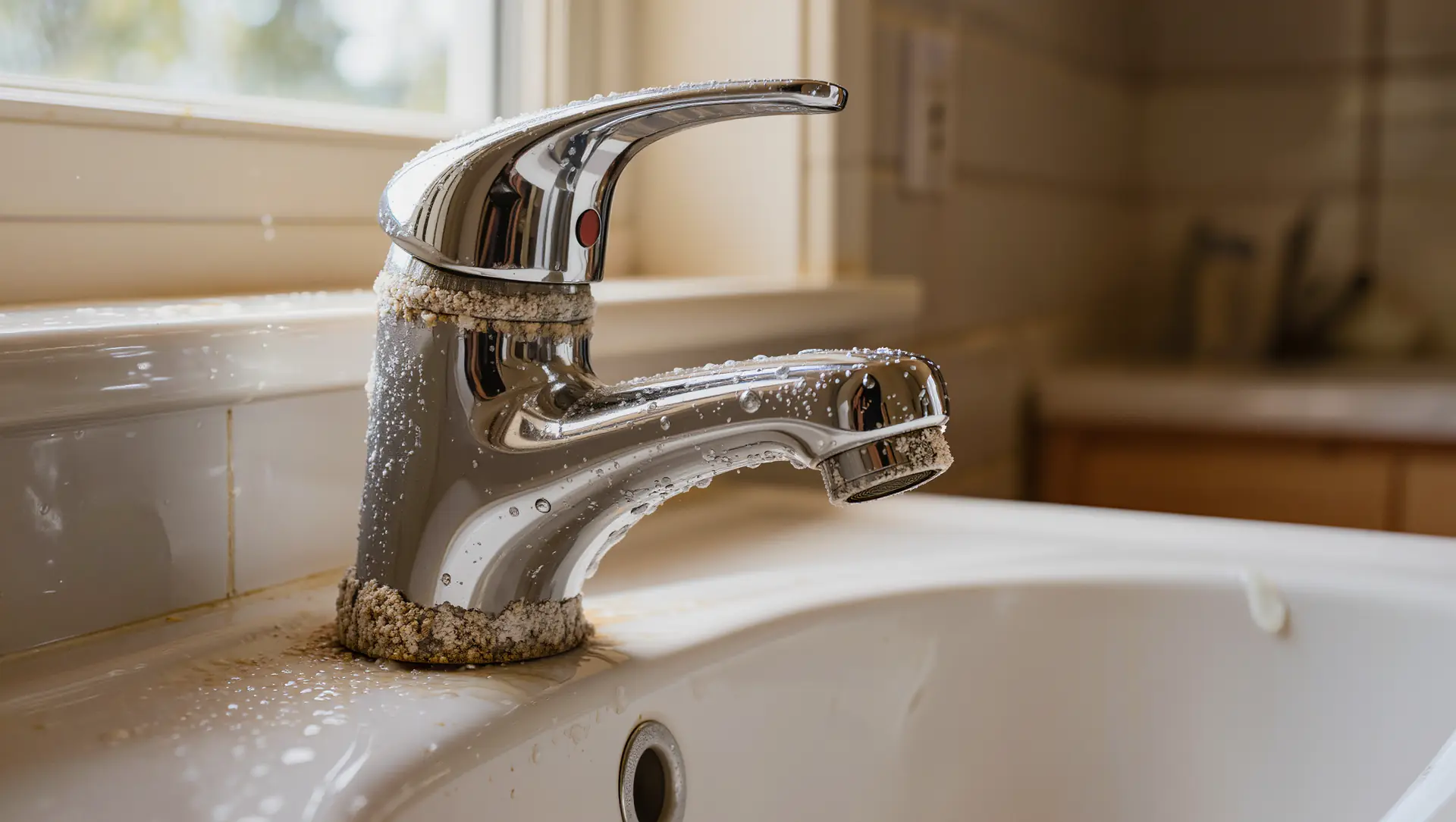
The shower door went cloudy the first summer and never cleared. The kettle grew a white crust you can snap off with a thumbnail. The dishwasher leaves spots, the soap won’t lather, and the water heater in the garage has started to rumble. None of it is bad luck. It is the water.
Phoenix municipal water typically tests between 12 and 20 grains per gallon of hardness. The scale that classifies water calls anything over 10.5 “very hard,” and then stops, because the people who wrote it apparently never visited Arizona.
Hardness is dissolved calcium and magnesium, and its defining habit is not staying dissolved. It comes out of solution on every surface it touches, for as long as you own the house. The arrangement works like a tax levied so gradually that the taxpayer thanks his luck he isn’t paying one.
The itemized bill nobody sends
- Your water heater dies young. Scale settles across the tank floor and insulates the burner from the water. The gas burns longer for the same heat, and the steel under the sediment cooks. That rumble is the sound of it happening, and the other noises mean something too. Valley tanks average 8 to 12 years; in soft-water states the same unit runs 15. That gap is the biggest line item: a water heater replacement pulled forward three to five years, every cycle, forever.
- Fixtures seize and drip. Cartridges and valve seats collect mineral until they weep. Each one is a small faucet repair. There are a lot of ones.
- Detergent doubles. Surfactants bind to minerals before they clean anything. Soap that won’t lather isn’t a cheap brand failing. Every brand fails in this water.
- Glass etches, tankless units choke. Shower doors frost permanently, and on-demand heaters need annual descaling or their heat exchangers narrow like old arteries.
For a family of four at Valley hardness, the running total lands between $500 and $800 a year. Not one bill. Several small ones, none memorable.
What a softener actually does
Ion exchange swaps calcium and magnesium for a trace of sodium. It removes hardness rather than persuading it to stick less. Installed downstream of the meter and upstream of the water heater, a properly sized unit takes the water to near zero grains.
Running cost is salt: $60 to $150 a year for most households. Against the annual tax above, the arithmetic is not close. The unit typically pays for itself in two to four years, then keeps paying. Soft water also changes the tank-or-tankless math.
Nobody moves to Phoenix for the water. Softening it is one of the cheaper concessions the desert asks of you.
The honest caveats
Salt-free “conditioners” change how minerals crystallize but don’t remove them. At our hardness they are a compromise, not a solution. Softened water on landscaping is money poured on gravel, so hose bibs stay hard. And if you are on well water in Cave Creek or Desert Hills, iron and sediment need filtration before softening, or you are treating the wrong problem.
We test hardness at your tap, free: your number, not a metro average. We will also tell you plainly when a softener won’t pay for itself in your house. Run your own numbers first with the hard water cost calculator.
hard waterwater softenerscosts