5 min readBleuwave Plumbing
The Annual Backflow Test Your City Remembers, Even If You Don’t
A brass assembly near the curb keeps whatever is in your building out of the public water supply. Once a year, your water provider wants proof it still works. Here is what that proof involves.
Water moves toward lower pressure. Every other fact about backflow follows from that one.
Your building is connected to a city main that normally runs at higher pressure than anything inside, so water flows in and stays in. Most of the time. When a main breaks down the street, or a fire crew opens a hydrant, pressure in the main can drop sharply for a few minutes. Suddenly your building is the high side. Water on its way to your sinks can reverse, and so can whatever else is connected to your plumbing. That is back-siphonage. Its mirror image, backpressure, happens when something inside the building (a booster pump, a boiler, a beverage carbonator) pushes harder than the main and drives water the wrong way.
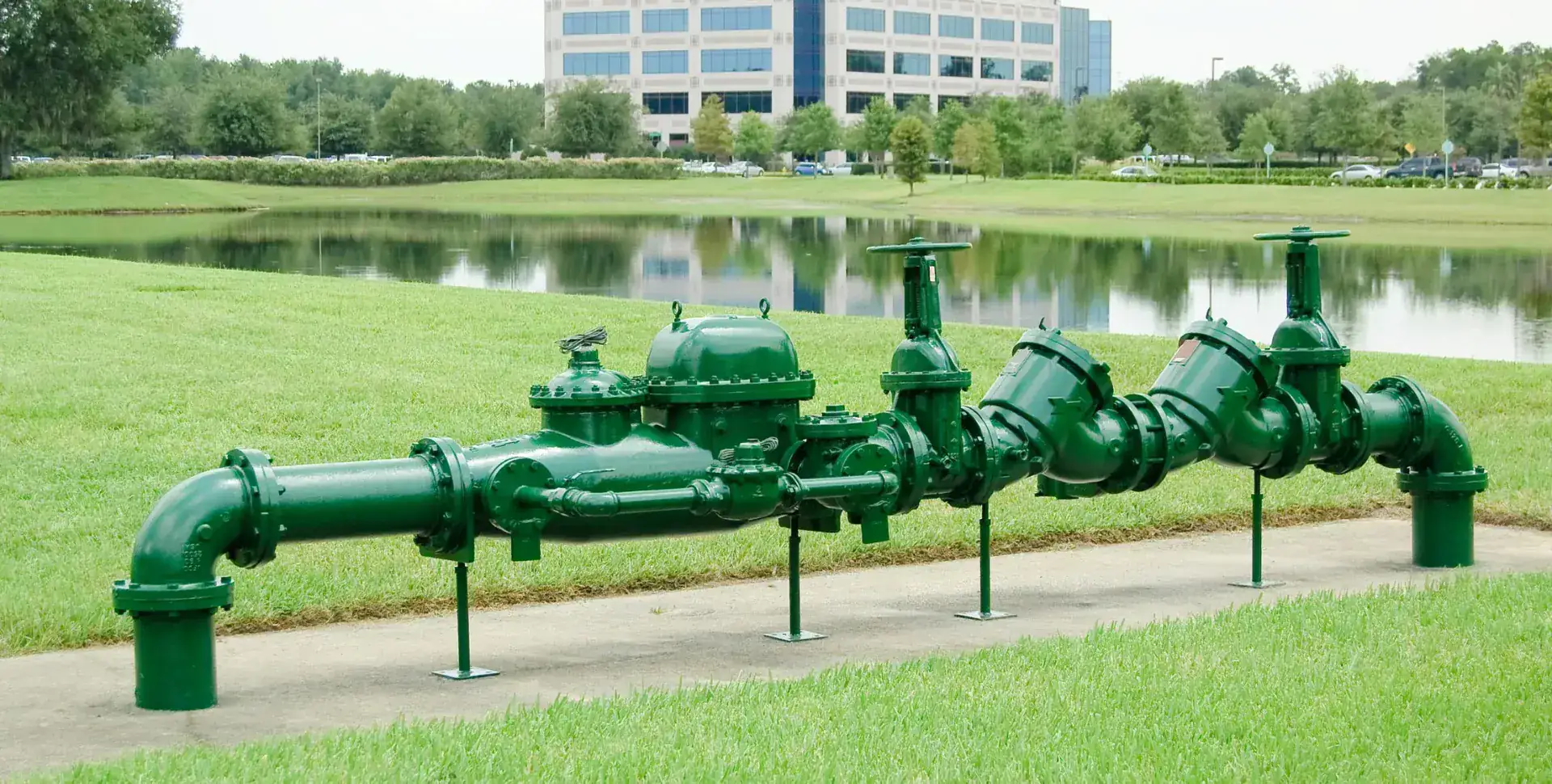
A backflow prevention assembly sits between your building and the public supply and closes when either happens. Your water provider wants it tested every year because the provider answers for the water in its mains, and the assembly on your service is one of the few things standing between your equipment and your neighbor’s kitchen faucet.
What your building is connected to
The trade term is cross-connection: any point where drinking water meets something nobody should drink. Commercial buildings are full of them.
- Irrigation. Sprinkler heads sit in soil, fertilizer, and whatever the landscape crew sprayed last week. An unprotected irrigation line is a straw into the flower beds.
- Fire sprinkler lines. The water inside can sit untouched for years. The fire service usually carries its own assembly.
- Boilers and hydronic systems. Often treated with chemicals to control corrosion and scale. Nobody wants those in the coffee.
- Soda and beverage systems. Carbonated water is mildly acidic, and if it backs into copper supply pipe it can dissolve copper into the water. That is why carbonators carry their own protection.
- Everything else. Dental and medical equipment, cooling towers, chemical dispensers at the janitor’s sink. The provider classifies each connection by hazard.
That classification decides which assembly you need. A double check assembly uses two spring-loaded check valves in series and suits lower hazards. A reduced pressure zone assembly, or RPZ, adds a relief valve between the two checks that opens and dumps water to the ground if either check stops sealing. Higher-hazard connections generally require an RPZ. Preference doesn’t enter into it.
Why once a year
Inside the assembly are rubber discs, seats, and springs, sitting in hard, pressurized water around the clock. Seats collect scale. Springs tire. A grain of debris lodges under a disc and holds it slightly open. None of this shows from the outside, and an assembly with a failing check looks exactly like a healthy one. A pressure test is the only way to tell them apart.
So most Valley water providers require commercial assemblies to be tested annually, with the results reported to the provider. Many also want a test after any installation or repair. The forms, deadlines, and methods of submitting results vary by city, which makes the notice your provider sends the document to follow. Providers track assemblies by location and serial number, and they know which ones are due. The reminder letter is not a suggestion. Missed deadlines escalate, and in some cases the provider can shut off service to the connection until the test is done.
Your water provider remembers the test date. The question is whether anyone in your building does.
What happens during the test
It is short and undramatic, which is exactly how it should go.
The tester confirms the assembly’s type, size, and serial number, and checks that it is the right device, installed correctly, for the connection it protects. Water through the assembly is shut off. Gauges go onto the small test cocks on the assembly body, and the tester measures whether each check valve holds the pressure difference it is supposed to hold and, on an RPZ, whether the relief valve opens at the right point. The shutoff valves on either side get checked too, because an assembly that can’t be isolated can’t be tested or repaired.
Supply through the assembly is off only while the test runs. Scheduling it before open, after close, or in a slow hour keeps it out of your business day entirely.
When it fails
A failed test usually means worn internals: a check disc that won’t seal, a weak spring, a relief valve fouled with debris. Most assemblies can be rebuilt with a parts kit, often on the same visit, and then retested. Old, damaged, or discontinued assemblies sometimes cost more to rebuild than to replace, and you should see both prices before anyone picks up a wrench.
Some problems announce themselves between tests:
- An RPZ that drips or dumps water. The relief valve opens when a check isn’t holding. A bucket underneath is not a repair.
- Pressure that is weak past the assembly and fine before it. Debris or failing internals are choking the flow.
- Physical damage. Test cocks bent by a landscaper’s trailer, a cracked body, a fresh coat of paint over the test cocks from somebody tidying up. Brass also has scrap value, which is why locking enclosures exist.
- New equipment. Adding irrigation zones, a boiler, or a beverage line can change the hazard classification and the assembly your connection needs. Ask before the install, not after the letter.
The paperwork is the product
To your water provider, the test report is a compliance document, so treat it like one. Keep each year’s results with the assembly’s location, type, size, serial number, test date, and outcome: passed, failed, or repaired and retested. File it where the next facility manager will find it. New owners and managers routinely inherit assemblies with no records at all, and the provider still expects the next test on schedule.
If you manage several sites, group the tests by area and month so they come due together instead of trickling in all year. A dozen letters becomes one scheduled day. The rest of that annual routine, from meter reviews to valve maps, is laid out in leak prevention for property managers.
Getting it off your desk
We test, repair, and replace commercial backflow assemblies, schedule the shutoff around your business hours, and document the results in the form your provider asks for. Testing is priced flat and agreed before we start, and any repair is quoted before a single part goes in.
When an assembly is part of a larger job, it gets planned in from the beginning: a new or replaced service line under commercial water and gas line work, treated water feeding equipment through commercial water filtration, or a new boiler installed alongside commercial water heaters. Adding equipment is the most common way a building ends up needing a different assembly than the one it has.
An RPZ pouring water is the one backflow problem that can’t wait for a slow Tuesday; call the 24/7 commercial line. Everything else, including the letter already on your desk, starts with a quick request for a test date. Licensed, insured, and bonded, ROC #340524, and veteran owned.
commercialbackflowcompliance