5 min readBleuwave Plumbing
The Morning the Hot Water Didn’t Come: A Downtime Plan for Business
Commercial water heaters rarely fail at a convenient hour, and the cost of the failure is almost never the heater. It is the day the business couldn’t open.
A confession most equipment salespeople won’t make: nobody can tell you the date your commercial water heater will fail. Not the manufacturer, not the service technician, not the rating plate on the side. What anyone honest can tell you is roughly how old it is, what shape it’s in, and what happens to your business on the morning it quits.
That last part is the one worth planning for.
Four businesses, one bad morning
A hotel’s heater gives out overnight. By 6:30 a.m. the front desk has taken its fourth call about cold showers, and the manager is deciding how many room nights to comp. The heater costs what it costs. The comps, the reviews, and the conversations at checkout are the real invoice.
A gym opens at 5 a.m. Members who came for a workout and a shower get the workout. A few of them start wondering whether the gym down the road has hot water.
A salon’s shampoo bowls run lukewarm. Color can’t be rinsed properly, clients can’t be washed comfortably, and a full book starts getting rescheduled by text, one apologetic message at a time.
A restaurant has it worst, because hot water is a condition of operating. The food code requires hot water at hand sinks and proper temperatures for warewashing. Without it a kitchen generally can’t serve, whatever the reservation book says.
The failure is the same in all four. The cost is not the heater. It is the day.
What actually fails
Commercial units heat far more water than residential ones and wear out on a faster schedule. The usual suspects:
- Sediment and scale. Valley water carries roughly 10 to 20 grains of hardness per gallon, and calcium comes out of solution whenever water is heated. In a tank it settles on the bottom and insulates the water from the burner; in a tankless unit or boiler it coats the heat exchanger. Either way the burner runs longer for the same output and the metal beneath the scale runs hotter than it was designed to. Recovery slows first. Failure comes later. The rumbling and popping in between are translated in what water heater noises mean.
- A spent anode. A tank’s sacrificial anode rod corrodes so the steel doesn’t have to. Once the anode is gone, the tank takes its place, and the eventual leak is the end of that tank.
- Ignition and controls. Igniters, flame sensors, gas valves, and control boards fail on units that are otherwise sound. These are often same-day repairs, when the part is available.
- Relief valves. A temperature and pressure relief valve that weeps is either failing or doing its job because something else is wrong, such as a waterlogged expansion tank. Either way it wants attention.
- Recirculation pumps and mixing valves. When hot water “takes forever” to reach the far end of the building, the heater may be fine. The pump that keeps the loop moving may not be.
The Valley shortens the schedule
A commercial heater installed on untreated Valley water has chosen a shorter life. Scale accumulates in proportion to the water heated, so the busiest heaters collect it fastest. Descaling on a set interval extends service life, and treating the water upstream extends it further, which is why commercial water filtration comes up in nearly every sizing conversation we have. The full ledger on hardness is in the quiet tax on every appliance.
One big unit, or two smaller ones
This is the most useful decision you can make before anything breaks.
A single large heater is simpler and usually cheaper up front. It is also a single point of failure. When it stops, everything stops.
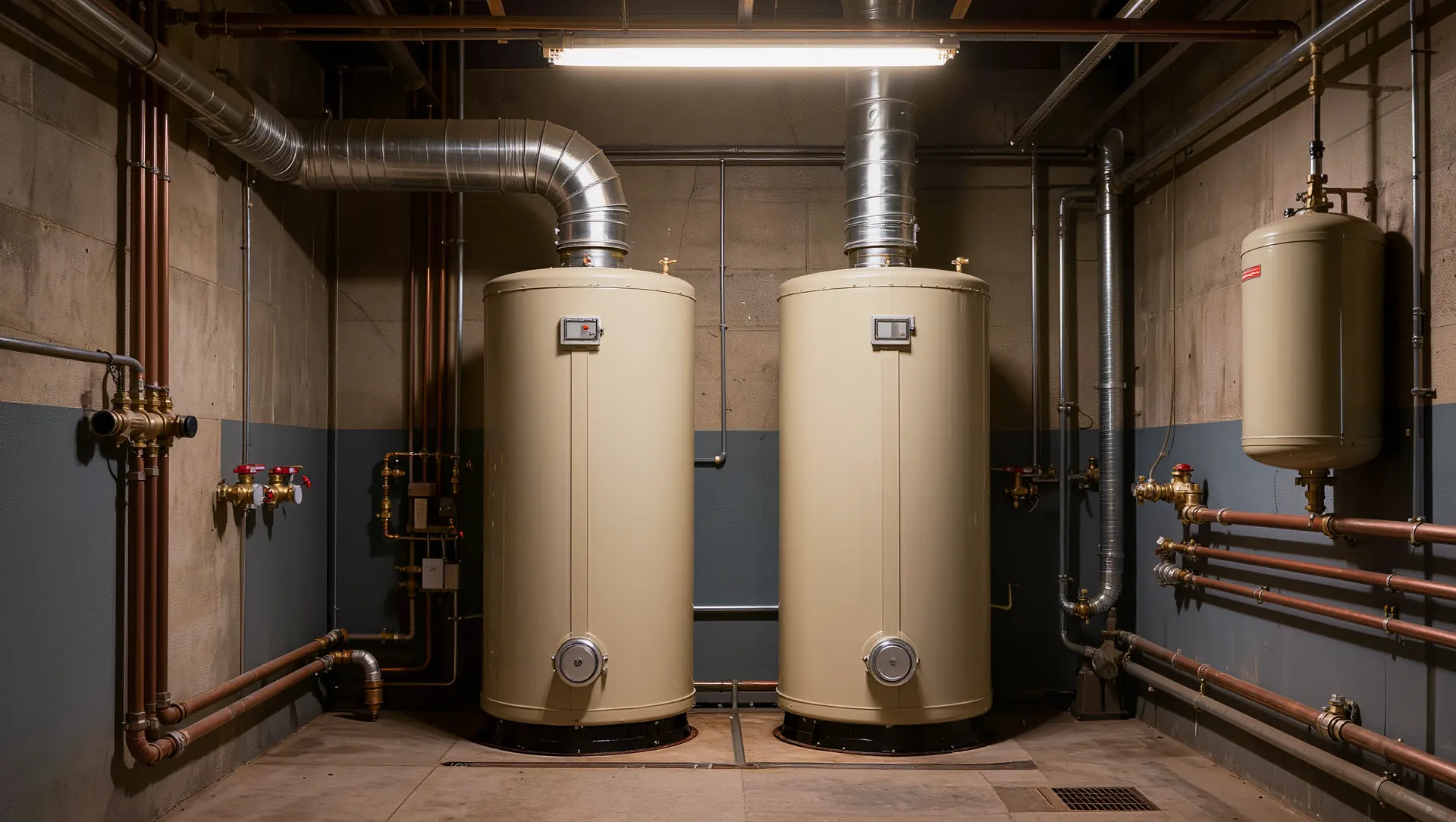
Two smaller units piped in parallel, each with its own isolation valves, cost more to install and take more floor space. But when one fails or goes down for descaling, the other keeps running, and the building gets reduced capacity instead of none. For a hotel that means shorter showers instead of cold ones. For a restaurant it can mean a slow night instead of a dark one. Many operations size the pair so either unit alone can carry the building through its quieter hours.
Redundancy comes in smaller sizes too. A booster heater at the dish machine lets the main system run cooler. A point-of-use heater can keep a hand sink in compliance while the main unit is being replaced. The load profile decides which approach fits, and whether any part of it belongs on demand rather than in a tank is a calculation we ran separately in tankless versus tank.
Planned replacement, or emergency replacement
An emergency replacement is a negotiation with circumstance. You get whatever capacity is available that day, installed under time pressure, into whatever gas supply and venting already exist. Sometimes that works out fine. Sometimes the building lives with an undersized heater for the next decade because it was the one on the shelf.
A planned replacement lets you size to actual peak draw, confirm gas supply and venting ahead of installation day, schedule the swap overnight or on your slowest day, and keep the old unit running until the moment of changeover. The heater costs about the same either way. Everything around it doesn’t.
The signs that the planning window is closing: a unit past the middle of its expected life in hard water, recovery falling behind at peak, a repair log that keeps growing, rust-colored water on the hot side only, and any moisture at all around the base.
Nobody gets to schedule a failure. The replacement is the part you still get to schedule.
The arithmetic of a closed day
Do this once, on paper, before you need it. Take an ordinary day’s revenue. Add the wages you’ll pay staff who can’t work, the comps and refunds, the perishables that don’t get used, and whatever a run of unhappy reviews costs you over the next month. That total is what a single point of failure puts at risk every day an aging heater keeps running.
Now set it beside the fix. Commercial water heater installation typically runs $3,500 – $18,000 installed, depending on capacity, the number of units, and any gas or venting work. Service visits typically run $250 to $900. For many businesses, a single closed day covers a meaningful share of a planned replacement, and a second unit starts to look less like a luxury and more like insurance with a pilot light.
What to do this month
Find the manufacture date on each unit’s rating plate. Write down what the building has for backup, if anything. Log hot-water temperatures at the farthest fixtures for a week, especially at your busiest hour. Then have someone look at the mechanical room while it is still quiet.
We service, repair, and replace commercial water heaters and boilers, size replacements to peak draw instead of the old nameplate, and schedule installation around your business hours. The price is flat and agreed before work begins, and financing is available on installations. If the hot water already didn’t come this morning, 24/7 commercial emergency service is the call to make first.
commercialwater heatersdowntime